Surrounded by Strangers, Alone in the Noise: What Coffee Shops Reveal About American Loneliness
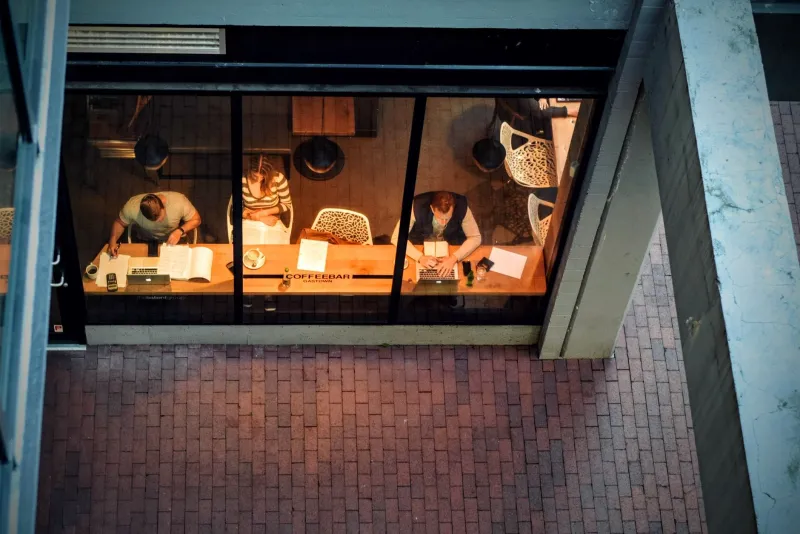
It's 11 a.m. on a Tuesday and every seat at the local indie café is taken. A woman in oversized linen is deep in a video call, muted, mouthing words at her laptop screen. Two college kids sit across from each other, both wearing noise-canceling headphones, both scrolling. A guy in his thirties has claimed an entire four-top with a single oat milk latte and what appears to be three open browser tabs about project management software. Nobody is talking. The room hums with the white noise of the espresso machine, lo-fi beats piped through ceiling speakers, and the collective, unspoken agreement that we are here together, and we are absolutely not going to interact.
This is the American third space in 2025. And honestly? It's a little heartbreaking.
The Third Space Mythology
Urban sociologist Ray Oldenburg coined the term "third space" back in the late '80s — the idea being that healthy communities need places beyond home (first space) and work (second space) where people can just be with each other. Barbershops, diners, front porches, corner bars. Places where regulars knew each other's names and conversations happened organically, uninvited, welcome.
The coffee shop was supposed to inherit that legacy. And in some ways, it did — except somewhere along the way, we brought our offices with us. We brought our anxieties, our deadlines, our carefully curated playlists designed to signal do not disturb. The third space became the second space with better lighting and a seasonal drink menu.
What's wild is that people choose this. Nobody is forcing anyone to work from a café when they have a perfectly functional apartment. The choice to be around strangers — even non-interactive, laptop-lit strangers — is deliberate. Which means the loneliness isn't incidental. It's kind of the point.
Ambient Humanity and Why We Crave It
There's a concept researchers have started calling "ambient sociality" — the low-grade comfort of simply being near other humans without the pressure of actual engagement. Think about how different it feels to work alone in your apartment versus working in a café. The productivity might be the same. The isolation, technically, is the same. But something about the background hum of other people existing near you scratches a primal itch.
We are, at our core, herd animals. And somewhere between the rise of remote work, the collapse of genuine community infrastructure, and the slow erosion of casual neighborly interaction, the coffee shop became a kind of surrogate village square — one where the villagers have all agreed, silently, not to make eye contact.
In cities like New York, LA, Chicago, and Austin, this dynamic is especially pronounced. People move to these dense, vibrating urban centers craving connection, then spend their days in the most populated rooms they can find, carefully insulated from the people in them. The headphones are less about the music and more about the message: I am here. Please leave me alone. I am so glad you're here.
The Performance of Presence
There's also something performative happening that we don't talk about enough. Showing up to a coffee shop isn't just about getting caffeine or finding a work spot — it's a mild act of self-presentation. The laptop sticker choices. The tote bag from that bookstore in Brooklyn. The specific drink order that signals your whole personality in four words or fewer.
Being seen working, being seen reading, being seen existing thoughtfully in a curated space — this matters to people in ways they might not consciously admit. Social media made us all a little bit aware that we're always potentially being observed, and the coffee shop is one of the few IRL arenas where that performance still plays out in real time, without a filter.
This isn't cynicism. It's just culture. Humans have always performed their identities in communal spaces — that's literally what fashion, manners, and public behavior are. The café just happens to be the contemporary stage where a very specific kind of aspirational, creative, independent-minded American goes to be witnessed being aspirational, creative, and independent-minded.
What Gets Lost in the Static
Here's the thing though: genuine connection is increasingly rare in these spaces, and that absence has a cost.
The U.S. Surgeon General's 2023 advisory on the loneliness epidemic wasn't subtle. Loneliness, the report noted, carries health risks comparable to smoking fifteen cigarettes a day. And while coffee shops aren't the cause of that epidemic, they've become a fascinating symptom — places where the desire for community is obvious and present, but the infrastructure for it has quietly been dismantled by social norms, phone dependency, and the general post-pandemic weirdness around interacting with strangers.
When's the last time someone at a coffee shop started a conversation with you that wasn't about whether you were using the outlet? When's the last time you did that?
There are pockets of resistance. Regulars who know the baristas by name. The occasional chess club that stakes out the back corner. Cities with café cultures that still lean into the European tradition of lingering, chatting, letting a single espresso become a two-hour social event. But these feel increasingly like artifacts.
Reclaiming the Cup
None of this is unsolvable. Some cafés are actively pushing back — no-laptop hours, communal tables with intentional programming, open mic nights that force the headphones off. There's a growing movement among younger urbanites to be more deliberate about third-space engagement, to treat the coffee shop less like a coworking space and more like the neighborhood anchor it was always meant to be.
But it requires something uncomfortable: the willingness to be a little vulnerable. To make eye contact. To say something dumb to a stranger and risk it going nowhere. To remember that the whole point of gathering was never just to be in proximity — it was to actually meet the people you're near.
The coffee shop, at its best, is still one of the most democratic rooms in America. Rich, broke, young, old, freelancer, retiree — everyone's welcome as long as they buy something. That's genuinely beautiful. We just have to decide whether we're going to keep treating it like a library with better espresso, or start using it for what it actually could be.
Put the headphones down. Just one earbud. See what happens.