Sipping on Status: The Identity Crisis Inside Your Coffee Order
There's a moment — you've probably lived it — where someone at a dinner party mentions their go-to coffee spot and the room shifts slightly. Eyes flicker. A subtle recalibration happens. Are they a Dunkin' person or a Blue Bottle person? Did they say single-origin with just a little too much reverence? Suddenly, a beverage preference has done the social heavy lifting of a LinkedIn profile and a Spotify Wrapped combined.
Coffee, somehow, became a whole thing.
It didn't happen overnight. The arc from utilitarian morning fuel to curated lifestyle accessory has been building for decades — but in the last ten years or so, specialty coffee culture in the US has crossed a threshold. It's no longer just about what's in the cup. It's about who you are because of what's in the cup.
From Diner Drip to Destination Roastery
Let's rewind a little. For most of the twentieth century, American coffee culture was democratic in the most unglamorous way possible. Diner coffee. Percolated, slightly burnt, endlessly refilled. It was functional. Nobody was posting about it.
Then came Starbucks, which gets a lot of heat now but genuinely did something culturally significant: it made coffee a customizable experience. Suddenly you weren't just ordering coffee — you were ordering your coffee. The Venti Caramel Macchiato with an extra shot was a small act of self-expression. Starbucks democratized the idea that your order could say something about you.
What came after was the so-called third wave — a movement that treated coffee with the same reverence reserved for natural wine or artisanal cheese. Single-origin beans sourced from specific farms in Ethiopia or Colombia. Pour-overs timed to the second. Baristas who could tell you the altitude at which the coffee was grown. Roasteries that looked like they were designed by the same person who did a boutique hotel in Williamsburg.
This wasn't just a shift in quality. It was a shift in language, in aesthetics, in the entire social grammar around a morning ritual.
The Instagram Shot as Cultural Artifact
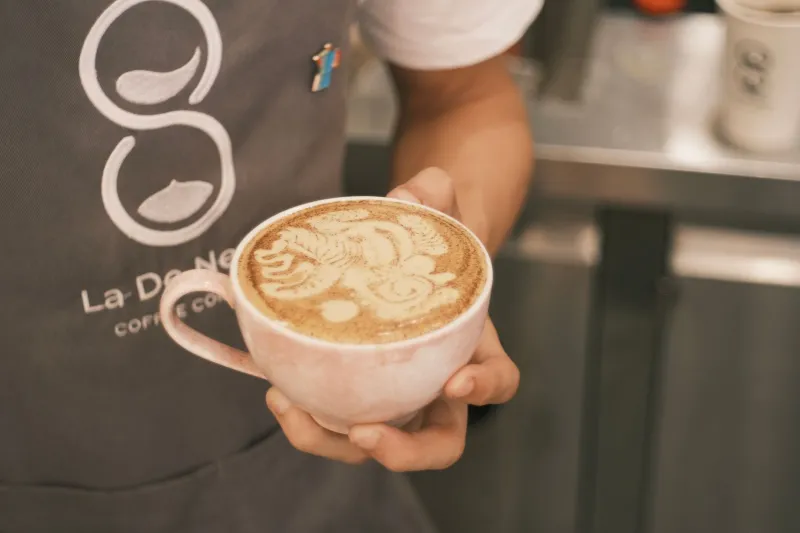
Latte art deserves its own cultural analysis. The rosette, the tulip, the swan — these aren't just flourishes. They're the moment coffee became fully photographic. A well-poured flat white is practically engineered for the grid. The ceramic matters. The table it sits on matters. The light matters enormously.
Instagram didn't create coffee aesthetics, but it turbocharged them into something almost architectural. Coffee shops started designing themselves around the shot. Exposed brick, terrazzo counters, Edison bulbs at just the right warmth. The cup became a prop in a larger mise-en-scène about who you are and how you choose to spend your Saturday morning.
And there's nothing inherently wrong with that. Aesthetics are a legitimate form of cultural expression. But it's worth sitting with the fact that a significant portion of what drives specialty coffee culture is its visual grammar — its ability to signal membership in a particular social stratum without saying a word.
The Gatekeeping Problem
Here's where it gets thorny. Coffee culture, particularly at the specialty end, has a gatekeeping problem that it hasn't fully reckoned with.
The language alone can be exclusionary. If you walk into a high-end roastery and don't know the difference between a washed process and a natural process, some spaces will make you feel that. The implicit message: real coffee drinkers know this stuff. Which means people who don't — often people who didn't grow up in spaces where this knowledge was casually transmitted — are quietly made to feel like outsiders in what is, at its core, a coffee shop.
There's also the price point conversation nobody wants to have. A specialty pour-over in a major US city can run you eight, nine, ten dollars. That's not accessible. And when coffee culture ties identity and sophistication so tightly to that specific tier of consumption, it's doing class work under the guise of taste. It's saying, essentially, that the $1.89 Dunkin' medium is for people who don't know better — which is a pretty gross thing to imply about a significant chunk of the American population who are just trying to get through the morning.
But Also: Real Community Exists Here
It would be reductive to leave it there, though. Because for all the performative posturing, specialty coffee culture has also built genuinely meaningful communities.
Independent coffee shops — the good ones, the ones that actually give a damn — function as neighborhood anchors. They're third spaces in a country that has systematically demolished third spaces. They host local artists. They hire from the neighborhood. They know your name and your order. That's not nothing. That's actually pretty rare and valuable.
And the passion that drives the coffee obsessive — the person who's genuinely curious about fermentation processes and elevation and the chemistry of extraction — that enthusiasm is real. It connects to a broader human impulse to find depth and meaning in ordinary rituals. Coffee as craft, as study, as conversation starter. There's beauty in that.
The problem isn't the passion. It's when the passion calcifies into hierarchy. When knowing things becomes a tool for exclusion rather than invitation.
What Your Order Actually Reveals
So what does your coffee order say about you? Probably less than coffee culture wants you to believe, and more than you'd like to admit.
It says something about geography — where you grew up, what was available, what was normalized. It says something about income and access. It says something about whether you've been welcomed into certain spaces or quietly turned away from them. And yes, sometimes it says something about genuine preference, about the flavors you've discovered and love.
What it doesn't say — despite the enormous cultural pressure to believe otherwise — is anything definitive about your intelligence, your sophistication, or your worth as a human being.
America has always been anxious about class in a way it refuses to directly name. Coffee culture is one of the places that anxiety gets displaced — where we use taste and consumption to do the sorting that we're not supposed to be doing openly. The $12 cortado and the gas station coffee aren't just different drinks. They've been loaded with meaning that was always about something other than coffee.
The most interesting thing we could do with that realization isn't to abandon the culture or the craft. It's to hold it more lightly. To let the rosette be beautiful without letting it be a credential. To let the diner cup be what it is — warm, reliable, unpretentious — without sneering.
Drink what you love. Just maybe don't let it drink you.