Tote Bag Transcendence: The Quiet Shame of Leaving the Museum with More Than You Came For
You stood in front of the painting for maybe four minutes. You tilted your head. You felt something vague and warm stir somewhere behind your sternum. Then the crowd shifted, someone's toddler shrieked, and you moved on. By the time you hit the gift shop, the painting was already becoming a memory—soft-edged and slightly blurred—and you were holding a $24 notepad printed with its image.
This is the museum gift shop phenomenon, and it has almost nothing to do with art.
The Promise We Walk In With
There's a particular kind of hope that brings people to museums in the first place. It's not always articulate, and it's rarely admitted out loud, but it's there: the idea that standing near great art will do something to you. Transform you a little. Crack you open. Give you the kind of quiet epiphany that makes the rest of the week feel more meaningful.
American museum attendance has been remarkably resilient for decades. The Met draws over five million visitors a year. The Art Institute of Chicago, the MOMA, the Getty—these aren't niche destinations. People want to be there. They want the experience. They're not dragging themselves through marble halls out of obligation. They're chasing something.
The problem is that the thing they're chasing is genuinely hard to catch. Art asks you to slow down, sit with discomfort, surrender your agenda. Most of us haven't practiced that in years. So we stand in front of the Vermeer for four minutes instead of forty, and then we drift toward the gift shop, where the longing can be converted into something concrete and purchasable.
What the Gift Shop Is Actually Selling
Here's the thing nobody at the museum will tell you: the gift shop is not a bonus. It's a psychological pressure valve. After ninety minutes of being confronted with beauty and historical weight and the creeping suspicion that you're not quite absorbing any of it, the gift shop offers resolution. You can do something. You can choose. You can acquire.
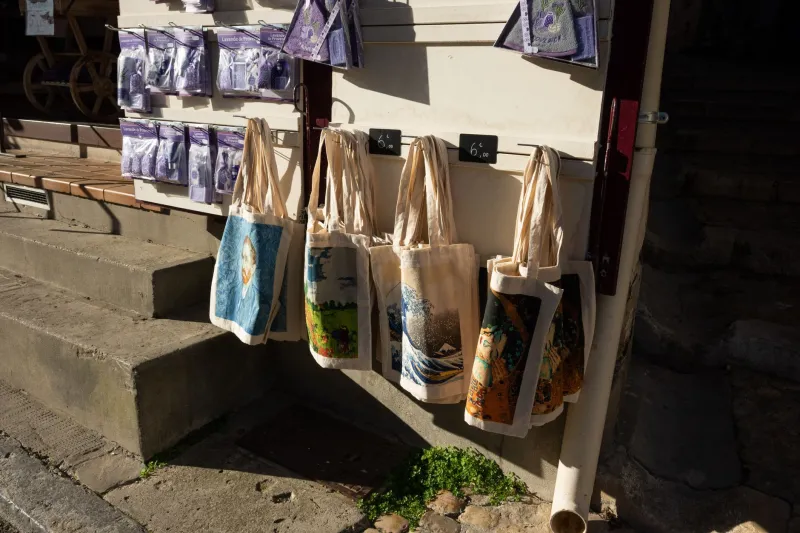
The tote bag is the perfect artifact of this transaction. It's practical enough to justify. It's visible enough to signal something about who you are. And it carries the museum's branding like a little portable proof that you were there, that you engaged, that you are the kind of person who goes to museums. The fact that it cost $38 for a canvas bag you could get at Target for $4 is not incidental—it's the whole point. The premium is for the story it tells.
Ceramic replicas of Greek urns. Monet water lily scarves. Frida Kahlo enamel pins. Keith Haring socks. These objects exist in a strange in-between space: too mass-produced to be art, too art-adjacent to be ordinary. They're cultural shorthand sold in bulk, and we buy them because we want the association without doing the full work of actually sitting with the real thing.
The Guilt That Comes Home With You
Most of the stuff ends up on a shelf. Or in a drawer. Or in that one corner of the apartment that's become a graveyard for Things That Felt Important at the Time. The tote bag gets used for groceries. The Vermeer notepad never gets written in because it feels too precious. The magnet goes on the fridge next to the one from that trip to Savannah in 2019.
And here's where the guilt creeps in—not loudly, just as a low hum. Because somewhere between the gift shop checkout and your kitchen counter, the object stopped being about the painting and started being about the performance of having seen it. You didn't buy a souvenir. You bought a substitute for the transformation that didn't quite happen.
This isn't a criticism of museum-going, or even of buying things in gift shops. It's a question about what we think culture is supposed to do for us, and how quickly we reach for a shortcut when it doesn't deliver on schedule.
When the Object Becomes the Experience
There's a version of this that's almost sweet. Your grandmother had a ceramic figurine from every place she ever visited. Those objects were her memories—tangible anchors to specific moments in her life. There's something genuinely human about wanting a physical trace of an experience.
But the museum gift shop has industrialized that impulse. It's been focus-grouped and margin-optimized. The items are designed to sell the idea of cultural engagement more than they are to commemorate any specific encounter with any specific work of art. You can buy a Van Gogh umbrella without ever standing in front of a Van Gogh. The gift shop has decoupled the object from the experience it's supposedly commemorating.
Some museums have started to reckon with this, at least aesthetically. The gift shops at places like the Broad in LA or the ICA in Boston stock work by living artists, local makers, genuinely unusual objects. The framing shifts from souvenir of a thing you saw to extension of the world the museum is trying to build. It's not a perfect solution, but it suggests someone is at least asking the right questions.
What You're Actually Looking For
The real issue isn't the tote bag. It's the gap between what we want from art and what we're willing to give it. Art doesn't work on our timeline. It doesn't deliver its payload in four minutes. It accumulates slowly, over return visits and quiet reflection and the willingness to feel confused or moved or unsettled without immediately reaching for your phone.
The gift shop is where we go when we've run out of patience with that process. When we want to leave with something to show for it.
Which is understandable. It's very human. But maybe the most honest thing we could do—the next time we're standing in that checkout line holding a $28 art book we'll definitely read—is admit what we're really buying. Not a piece of culture. Not proof of our depth. Just a small, overpriced receipt for the experience we almost had.
And maybe go back next week and try again.